The blind spot every data leader knows
Your team runs dozens, sometimes hundreds of pipelines, background jobs and AI-assisted workflows every day. Some are triggered from the platform. Others run on a schedule. Still others fire on cloud compute when volumes spike.
Yet when something breaks, the first question is always the same: What happened?
Too often, the answer lives in scattered tools, engineer-only dashboards, or nowhere at all. Pipelines fail quietly. Background work stays invisible to the business. AI spend becomes a line item no one can explain. Recovery means rerunning everything or opening another ticket and waiting.
Observability should not be a side project you fund after the platform is live. It should be how the platform works from day one.
The cost of the blind spot is real: delayed decisions, repeated work, unexplained AI invoices and teams that spend more time reconstructing history than improving outcomes. Leaders deserve the same clarity for data operations that they expect from financial or customer systems.
Agents that watch built in, not bolted on
At BigHammer, we treat observability as a product capability, not an integration exercise.
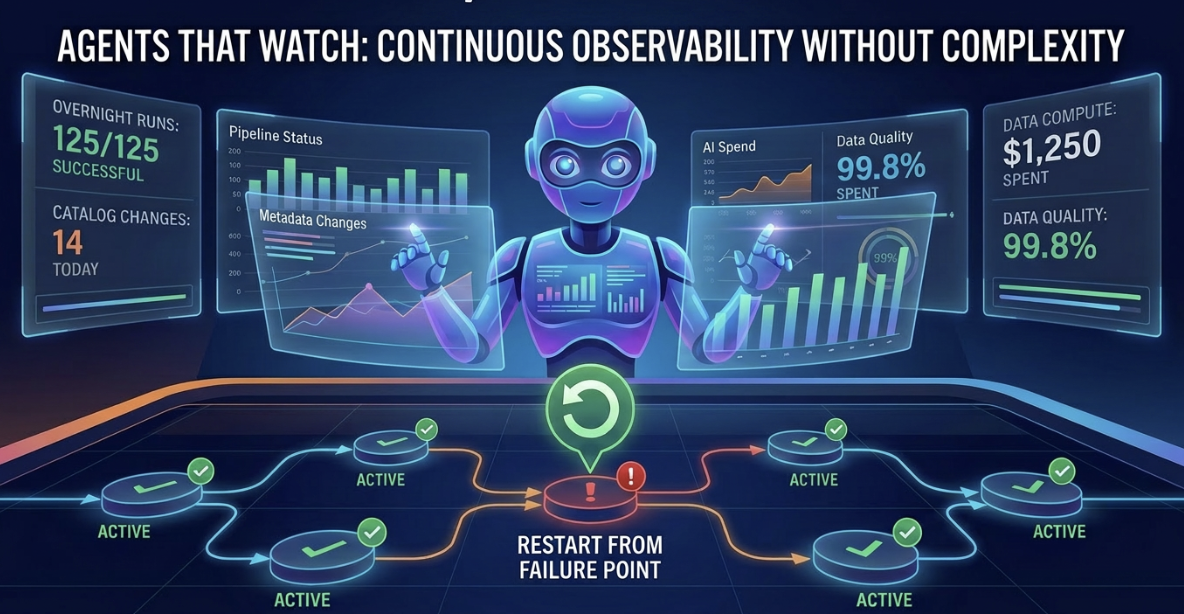
Think of it as agents that watch: the platform continuously records what runs, what succeeds, what fails, what it costs, and what changes in your data catalog, so your people focus on decisions, not detective work. No manual instrumentation. No assembling a patchwork of log tools, alert systems and AI tracing products.
Everything surfaces in DataOps, a single area of the product built for operators, data owners, and executives who need answers fast.
You do not configure a dozen integrations or train the business on another vendor’s dashboard. You open DataOps and see what the platform already knows.
DataOps: one place to see everything
DataOps brings operational visibility together instead of spreading it across five different products. Here is what each part delivers for the business.
Ops Hub is your operational memory. Search any job, see what ran and when, filter by project or status, and explore a timeline of activity when you need to investigate. When something fails, you do not have to rerun the entire pipeline. You can restart from the point of failure and pick up where work left off, saving time, compute, and credibility with downstream teams.
Control Operations is the control tower for your data connections. See batch health, track inputs as they are received and processed, review errors and quarantined records, monitor schema drift, and check SLA status, before issues reach your customers or regulators.
Alerts and notifications keep teams ahead of problems. When workflows succeed or fail, the right people are notified in a project-scoped inbox, so operations can act before users feel the pain.
Process Audit gives you an end-to-end view of orchestration runs: every stage, every step, duration, outcomes and artifacts. That is the audit trail compliance and risk teams expect and the clarity operations needs for post-mortems.
LLM Observability brings transparency to AI. See every agent execution, total cost in dollars, token usage, and success rates. Drill into individual runs when you need governance or quality review. without paying for a separate AI observability product on top of your data platform.
For organizations scaling AI inside data pipelines, that visibility is not a nice-to-have. It is how finance, risk and product leadership stay aligned on what agents are doing and what they cost.
The data catalog is watched too
Observability in BigHammer is not limited to jobs and pipelines. The catalog itself is under the same watch.
When your team renames a data source, adds a new field to a layout, updates business glossary or domain definitions, or changes how pipelines and flows connect, the platform records it automatically. You see who changed what, when and what changed (before and after), without asking engineering to dig through database logs.
Catalog Audit Trail in the data catalog gives stewards and designers a searchable history across catalog entities: data sources, layouts, fields, domains, glossary terms, and related definitions. That is the governance layer executives expect when data definitions drive reporting, compliance and customer-facing products.
Data lineage is part of the same story. When relationships shift between pipelines, flows, and connections, those updates are tracked so teams understand how data moves through the platform, not just that a job ran, but how the catalog model behind it evolved.
Job observability tells you what ran. Catalog observability tells you what your organization changed in the data foundation. Together, they answer the full question: What happened to our data platform operations and definitions?
"You shouldn't need a separate tool to know what your data platform did last night."
Everywhere your pipelines run, one audit trail
A common question from technology leaders: We schedule work in Airflow and run heavy jobs on cloud compute, do we still get one view?
Yes.
Whether someone kicks off work from the UI, a job runs in the background, a nightly Airflow schedule fires, or processing happens on managed compute, the same step-by-step history appears in DataOps. Failures tie back to the right pipeline, ingestion group, or flow not to anonymous cluster logs that only engineers can interpret.
Scheduled jobs that fail can be restarted from where they stopped, just like interactive runs. Ad-hoc actions, nightly batches and compute-backed processing share one operational story.
Without complexity
BigHammer observability is designed to reduce friction, not add it.
Everything in one story. Interactive work, background processing, scheduled orchestration, compute runs, catalog changes, and lineage updates all feed the same philosophy of continuous watch, operations in DataOps, catalog history where stewards work.
AI visibility included. LLM observability is part of the platform, with cost dashboards and run-level detail, so AI spend is visible to the business, not hidden in engineering tools.
Recovery built in. Failed workflows can be restarted or resumed from audit history. Operations does not need a separate engineering runbook for every failure mode.
Cloud-ready. When you deploy on AWS, GCP, or Azure, observability extends to your enterprise cloud environment, so platform teams can align BigHammer with the monitoring and logging standards you already use in production.
Who benefits
Executives gain visibility into AI spend, fewer surprise outages, and faster answers to "what happened?" without waiting on a war room.
Operations get one place to monitor, alert, and recover, instead of chasing status across email, tickets and tribal knowledge.
Compliance and risk rely on searchable process history, catalog change audit and clear lineage when regulators or auditors ask for evidence, not just job logs, but who altered definitions and relationships.
Data stewards and designers use Catalog Audit Trail to review layout and glossary changes without reconstructing history from tickets or spreadsheets.
Data product owners use Control Operations to catch batch issues, drift, and SLA risk before they become customer-facing incidents.
Observability as a principle, not a project
The best data platforms do not ask you to buy observability twice: once for pipelines, again for AI, and again for orchestration.
They watch themselves.
BigHammer DataOps is that watch, continuous, automatic and understandable for the business.
That is the difference between owning a data platform and renting a collection of tools. When observability is native, you shorten incident cycles, justify AI investment with facts, and give every stakeholder a shared picture of operational health.
If your organization still cannot see background jobs, scheduled runs, or AI spend in one place, it may be time to ask whether your platform was built for operators or only for engineers.
How does your team see what ran last night and what it cost?