Modern data engineering teams are overwhelmed, not because they lack talent, but because the traditional pipeline operating model no longer scales.
Ask any data engineer what they actually spend most of their time on.
Not what the roadmap says.
Not what the role description says.
What they truly spend their week doing.
The answer is almost always the same:
Fixing things.
Failed overnight jobs. Silent schema changes that quietly break downstream logic. Data quality issues that surface in executive dashboards at the worst possible moment. Manual deployment workflows that turn a small pipeline update into a cross-team operational event.
For many organizations, reactive maintenance consumes a major portion of engineering capacity. Meanwhile, requests for new integrations, analytics datasets, AI-ready data products, and operational reporting continue to pile up.
"The pipeline is the engine of the modern data organization. But in too many enterprises, that engine is consuming the very team responsible for scaling it."
Why Pipeline Complexity Keeps Winning
Pipelines look simple from a distance:
Ingest. Transform. Deliver.
In reality, production-grade data pipelines are deeply interconnected operational systems. They involve ingestion from multiple source systems, orchestration dependencies across jobs, evolving transformation logic, data quality enforcement, observability, SLA management, governance, lineage, infrastructure optimization, and controlled deployment.
Each layer introduces its own tooling, dependencies, and failure modes.
As organizations expand their data initiatives, complexity scales faster than engineering capacity. Most companies try to solve this by adding more engineers, more tools, and more process.
But the underlying model remains unchanged:
Humans manually build, operate, monitor, and maintain everything.
That model does not scale.
The result is a familiar cycle:
More pipelines → more maintenance → less innovation capacity → larger backlog → more delivery pressure → more fragile systems.
This is the pipeline debt spiral.
The team that was supposed to accelerate the business gradually becomes the operational bottleneck.
The Three Pipeline Problems That Never Go Away
The first problem is that pipeline creation remains specialist-heavy.
Building production-grade pipelines still requires scarce engineering expertise: source integration, transformation development, orchestration configuration, quality enforcement, monitoring, and deployment engineering. As a result, business requests spend weeks, sometimes months, waiting for engineering bandwidth.
The second problem is that maintenance scales with every pipeline.
Every new pipeline introduces long-term operational burden: schema drift, source instability, performance degradation, logic changes, SLA tuning, dependency management, and infrastructure optimization. Over time, maintenance becomes the dominant consumer of engineering capacity.
The third problem is that monitoring is reactive instead of operationally aware.
Traditional monitoring systems often detect what already failed. By the time alerts fire, downstream reports may already be incorrect, dashboards may already be stale, data products may already be impacted, and trust in the platform may already be damaged.
This is not just an operational problem.
It is a business trust problem.
A Different Model: The Orchestrating Agent
BigHammer approaches pipeline operations differently.
Not as another orchestration tool.
Not as a coding copilot.
But as an autonomous orchestration layer for the complete pipeline lifecycle.
BigHammer's Agent Pipeline enables organizations to move from manually operated pipelines to autonomously orchestrated data operations.

Pipelines can be described in natural language, generated and validated automatically, deployed with built-in rollback, monitored continuously, optimized for cost and performance, and evolved as business requirements change.
For example, a team can describe a requirement in plain English:
"Build a daily pipeline that ingests Salesforce transactions, enriches them with ERP product data, applies revenue recognition logic, and delivers curated warehouse tables before 6 AM."
The orchestration agent handles source mapping, transformation generation, orchestration setup, validation logic, quality checks, deployment preparation and testing workflows.
The specialist bottleneck around pipeline creation is dramatically reduced.
From Monitoring to Operational Reliability
Modern enterprises do not simply need pipelines that run.
They need pipelines that behave predictably.
The real operational challenge is not just processing data fast enough. It is ensuring the right data arrives, in the right form, within the right business window, consistently.
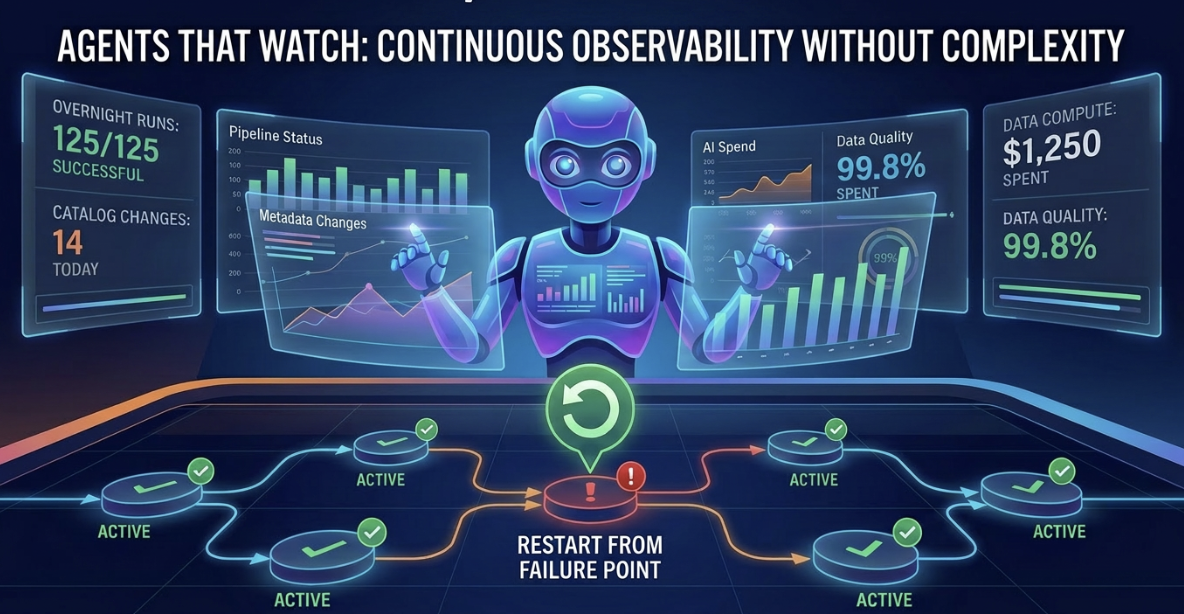
BigHammer continuously monitors pipeline behavior across data, performance, freshness, dependencies, and expected business timelines.
The operating model shifts from: "Did the pipeline fail?"
to: "Is the pipeline still behaving within expected business conditions?"
That distinction fundamentally changes how enterprise data operations scale.
BigHammer's orchestration layer continuously understands whether critical data is arriving on time, whether freshness expectations are being maintained, whether downstream dependencies are at risk, whether quality thresholds are being respected, and whether business-facing commitments are likely to be impacted.
When failures or anomalies occur, the platform performs lineage-aware diagnostics automatically. Engineers receive the originating failure point, impacted downstream systems, probable root cause, and recommended remediation path.
Teams receive diagnosis instead of alert noise.
The goal is not just observability.
The goal is operational reliability.
The Organizational Impact
For data engineering teams, capacity shifts away from operational firefighting toward strategic platform development. Backlogs reduce. Delivery velocity improves. Operational fatigue decreases.
For business stakeholders, new integrations and data products move faster. Pipeline reliability improves. Trust in enterprise data increases.
For data leadership, pipeline operations become measurable and governable across operational efficiency, infrastructure cost, SLA adherence, delivery velocity, and platform ROI. The pipeline estate becomes manageable as a strategic asset rather than an operational burden.
BigHammer also enables continuous cost and performance optimization across compute allocation, workload scheduling, storage lifecycle, transformation efficiency, and resource utilization patterns. The pipeline estate becomes continuously self-optimizing instead of continuously accumulating waste.
And as business needs evolve, BigHammer helps modernize legacy ETL and orchestration stacks with dramatically lower manual effort. Legacy workflows can be translated into modern cloud-native pipeline architectures while maintaining operational continuity.
From Manual Pipelines to Autonomous Data Operations
Pipeline complexity has outgrown the human capacity to manage it manually.
That is the core challenge facing modern data organizations.
The future of data engineering is not simply better tooling.
It is autonomous orchestration.
One intelligent agent governing the complete lifecycle: creation, deployment, monitoring, optimization, maintenance, and evolution.
From raw data to refined insight.
Autonomously.
That is the model BigHammer is building.
BigHammer.ai brings autonomous orchestration to every pipeline stage, helping data teams move from reactive maintenance to reliable, AI-ready data operations.