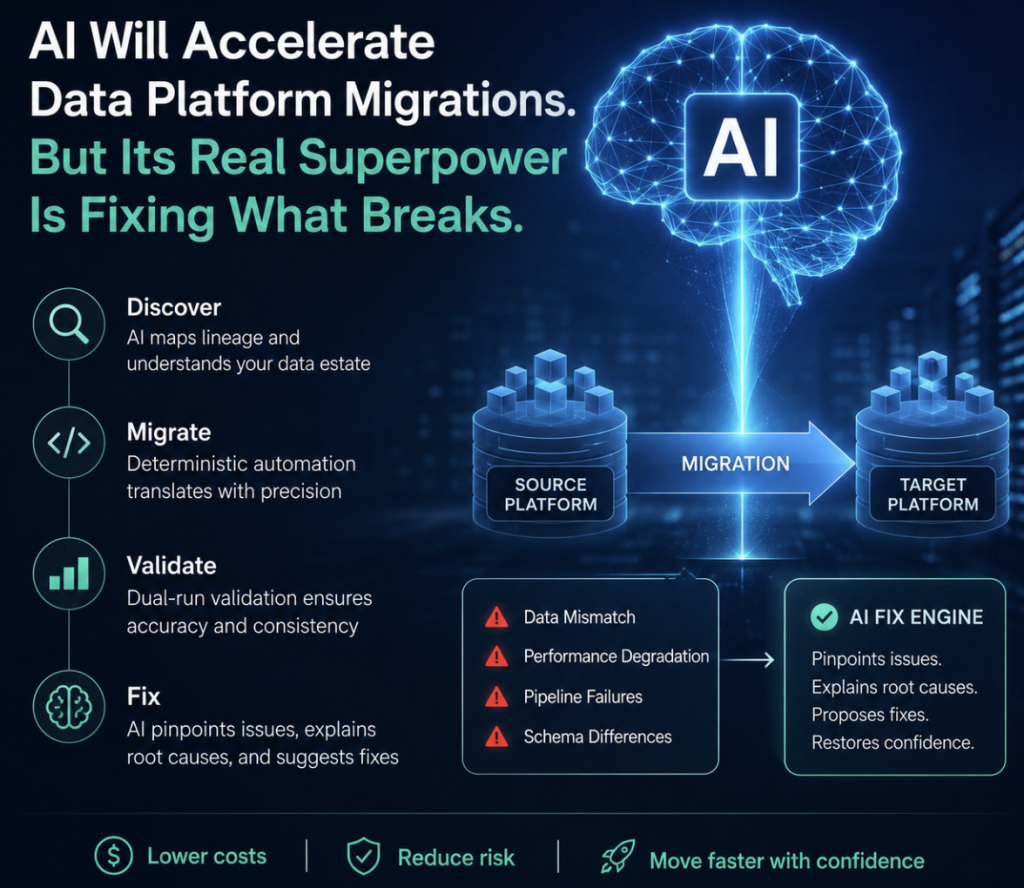
AI Will Accelerate Data Platform Migrations. But Its Real Superpower Is Fixing What Breaks.
Over the past year, I’ve noticed a shift in conversations with data and engineering leaders.
The discussion is no longer just about modernizing data platforms.
It’s about flexibility.
As organizations look to optimize compute costs, avoid vendor lock-in, and support multi-cloud strategies, many are asking the same question:
How do we move workloads to the most cost-effective runtime without disrupting the governance, security, and reliability we’ve spent years building?
The opportunity is significant. The challenge is that migrations remain one of the most expensive and risky initiatives in the data landscape.
And despite all the excitement around AI, most organizations are focusing on the wrong part of the problem.
The Real Bottleneck Isn’t Translation
When people think about migration, they often imagine code conversion.
Convert the SQL.
Convert the notebooks.
Convert the orchestration.
Move on.
But anyone who has lived through a large migration knows that code translation is rarely what determines success.
The real challenge begins after the code has been converted.
Large enterprises often have hundreds of pipelines, thousands of SQL objects, multiple repositories, orchestration workflows, and years of accumulated business logic.
The difficult questions emerge during validation:
- Why did row counts change?
- Why does a dashboard no longer match historical reports?
- Why is a pipeline suddenly taking three times longer to run?
- Why did a previously successful workload fail under a different runtime?
- Which downstream systems are affected?
This is where migration projects spend most of their time.
Not translating code.
Finding and fixing what broke.
AI Is Transforming Discovery
Before a migration even begins, organizations need to understand what they have.
Where are the pipelines?
What depends on what?
Which workloads are business critical?
Which assets should move first?
AI can dramatically accelerate this process by scanning repositories, analyzing lineage, identifying dependencies, classifying workloads, and estimating migration complexity at a scale that would be difficult to achieve manually.
For many organizations, this visibility alone removes weeks or months of effort.
But discovery is only the first step.
Trust Comes From Validation
No executive signs off on a migration because the code looks correct.
They sign off because the outcomes are correct.
This is why I believe dual-run validation will become a standard pattern for enterprise migrations.
Instead of translating code and hoping for the best, organizations execute the source and target pipelines in parallel and compare results throughout the workflow.
Schemas.
Row counts.
Aggregations.
Business metrics.
Data hashes.
The goal is simple:
Prove that the migrated pipeline produces the same business outcome as the original.
But validation creates a new challenge.
What happens when the results don’t match?
This Is Where AI Delivers Its Greatest Value
When a validation failure occurs, engineers often spend days or even weeks tracing lineage, reviewing logs, comparing execution plans and investigating runtime behavior.
This is where AI can fundamentally change the economics of migration.
Imagine a system that can:
- Identify the exact transformation where source and target results diverged.
- Trace the impact across downstream pipelines, reports, and datasets.
- Explain the likely root cause in both technical and business terms.
- Highlight platform-specific behavior differences.
- Recommend remediation options and generate proposed fixes for review.
Instead of manually searching for the problem, teams can focus on validating the solution.
The result is not autonomous migration.
The result is dramatically faster recovery when things go wrong.
The Future Is Hybrid Automation
The organizations that succeed will not rely solely on AI or solely on manual effort.
They will combine three capabilities:
Deterministic Translation
Rule-based compilers and transformation engines perform repeatable, auditable migrations where precision is non-negotiable.
AI Diagnostics
AI helps understand systems, analyze lineage, investigate failures, and accelerate remediation.
Human Governance
Engineering teams remain accountable for business outcomes, approvals, and production decisions.
Each plays a different role.
Together, they create a migration process that is faster, safer, and more scalable than either humans or AI can achieve alone.
Why This Matters
Most organizations already know there are opportunities to reduce compute costs and increase platform flexibility.
What slows them down is not technology.
It is uncertainty.
The fear that something critical will break during migration and that finding the root cause will take weeks.
AI is beginning to reduce that uncertainty.
Not because it can magically rewrite every workload.
But because it can help teams understand systems faster, validate outcomes with greater confidence and resolve failures far more efficiently.
And that may ultimately be AI’s most valuable contribution to enterprise data migrations:
Not writing the code.
Giving organizations the confidence to change it.
Data & Engineering Leaders: Where does your migration effort spend the most time today translation, validation or troubleshooting? I’d be interested to hear where AI is creating the most value in your organization.